Version HTML de base


de
HHXZVH GUXNNHQ
précepteur des enfants de Henri II. Son travail permit à l’Occident de lire le moralisateur
grec. Dédiée à Charles IX, ce recueil traite d’une variété de sujets tels que : «La malignité
d’Hérodote», «D’Isis et d’Osiris», «Comment il faut lire les poêtes», «La curiosité», «La
fatale destinée», «Le banquet des sept sages»... Exemplaire réglé et à grandes marges.
# Machiels P-1023; # Adams P-1623 (éd. de 1567); # Graesse V-367; # Biogr. univ.
I-621/623; # pas dans Soltész, ni Brunet.
325 — (Philosophie) -
9(5*,/,2 3ROLGRUR 'LDORJRUXP > @
Basileae [Bâle], apud Michelem Isingrinium, 1553.
In-8° : [5]-279 pp. (rare small stains and handwritten mentions, last lf. slightly browned).
0RGHUQ ELQGLQJ EUDGHO IXOO PDUEOHG EOXH SDSHU ÀDW VSLQH EOXH HGJHV
Est.
:
600/ 800 €
Containing 5 philosophical or moralizing speeches : «De iureiurando et periurio, lib. I»
(dedicated to John Dudley, 1st duke of Northumberland), «De veritate et mendacio, lib. I»,
«De patientia eiusque fructu, libri II», «De vita perfecta, lib. I» and «De prodigiis et fortibus,
libri III». Vergilio (1470-1555), Italian ecclesiastical become historian, went to England and
received the favors of Henry VII and Henry VIII. Author of several books including «De
inventoribus rerum libri VIII» in which he presents the origins of the religious ceremonies
and his famous «Anglicae historiae».
# Adams V-453; # Machiels V-158; # Soltész V-197; # Graesse VII-284; # Biogr. univ.
XXXIII-681/682; # not in Brunet.
5pXQLRQ GH FLQT GLVFRXUV SKLORVRSKLTXHV HW PRUDOLVDQWV GH FHW KLVWRULHQ HFFOpVLDVWLTXH LWDOLHQ LQVWDOOp
HQ $QJOHWHUUH HW TXL UHoXW OHV IDYHXUV GHV URLV +HQUL 9,, HW +HQUL 9,,, %UDGHO SDSLHU PDUEUp EOHX
326 — (Religion, Bible) -
$5(7,86 %HQHGLFWXV &RPPHQWDULL LQ HSLVWRODP '
3DXOL DG *DODWDV IDFLOL SHUVSLFXD PHWKRGR FRQVFULSWL > @ 3RVWHULRU KDHF HGLWLR
superiori emendatior aucat est Isagoge in ipsam epistolam.
Morgiis [Morges, Lausanne], excudebat Joannes le Preux, 1580 [- 1583].
4 parts in 1 vol. in-8° : 160-[5-3 bl.], 173-[3], [16 engraved title incl.]-300-[4 bl.], engraved title-[2 bl.]-425-
[3 bl.]-[11] pp. (some repairs in the paper, 1 with small loss of text, tears with lack, some spots and foxing,
handwritten mentions).
Contemporary binding : full pigskin blind stamped with roll borders
FKDUDFWHUV LQ PHGDOOLRQ ÀRUDO DQG YHJHWDO RUQDPHQWV DQG EUDVV FODVSV
title on ribbed spine (binding slightly dirty, corners slightly dulled).
Est.
:
600/ 800 €
First edition
of the 2 last parts of these commentaries on
4 epistles by Paul (ad Galatas, ad Ephesios, ad Philippenses,
Colossenses). Aretius (1505-1574) was a theologian and
botanist. He helped in the discovery of new plants which makes
him considered as one of the founders of botany. Professor
of logic in Marbourg and later professor of theology in Berne
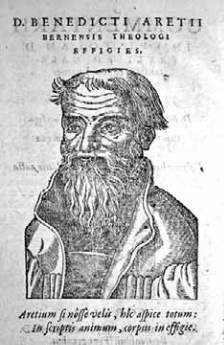
according to Calvin’s doctrine. Illustrated with Aretius’ portrait at
the back of the titles.
# Adams A-1605, A-1606 (ad Ephesios, ed. : 1579), A-1607 and
A-1609; # SoltészA-490 (ad Timoth., ad Titum, and ad Philemon);
# Biogr. univ. II-183; # not in Machiels, Brunet, Graesse.
eGLWLRQ RULJLQDOH GHV GHX[ GHUQLqUHV SDUWLHV GH FHV FRPPHQWDLUHV VXU
pSvWUHV GH 3DXO ,OOXVWUp GX SRUWUDLW GH O¶DXWHXU DX YHUVR GH FKDTXH WLWUH
3OHLQH SHDX GH WUXLH GH O¶pS UHO OpJ VDOLH FRLQV OpJ pPRXVVpV