




 144 / 239

143
259
[
LAFAYETTE
, Gilbert du Motier, marquis de]
Lettre autographe signée par Elijah Paine
Montpellier, Vermont, 28 juin 1825
3 pp. in-4, papier filigrané “Owen & Hurlbut”
EXEMPLAIRE DE LAFAYETTE. LETTRE D’HOMMAGE ÉCRITE
PAR L’ANCIEN SÉNATEUR DU VERMONT ET COMBATTANT
DE LA GUERRE D’INDÉPENDANCE
“The citizens of Montpellier & the vicinity have assembled to bid you
welcome to this recently created Village [and congratulating you] on
having so nearly completed the tour of the United States (...) When you
left this Country after the war of the Revolution, the State of Vermont
had but just begun to have a name. At that time almost the whole State
was a wilderness. Yet we are proud of some of the parts performed in
that war by the arms of Vermont... The State of Vermont cannot show
to you large towns & cities ; but it can show to you what is perhaps
of as much consequence. It can show to you a sober, substantial,
intelligent & well informed yeomanry”
Montpelier (“this recently created Village”) is of course now the
state’s capital. Elijah Paine (1757–1842) was a United States
Senator from Vermont, serving as a Federalist (1795-1801),
and thereafter a long-serving United States federal judge. Born
in Brooklyn, Connecticut, Paine attended the public schools.
He served in Continental Army during the Revolutionary War
(1776-1777), and graduated from Harvard College in 1781. His
son, Charles Paine, was Governor of Vermont (1841-1843).
400 / 600
€
260
LAFAYETTE
, Gilbert du Motier, marquis de
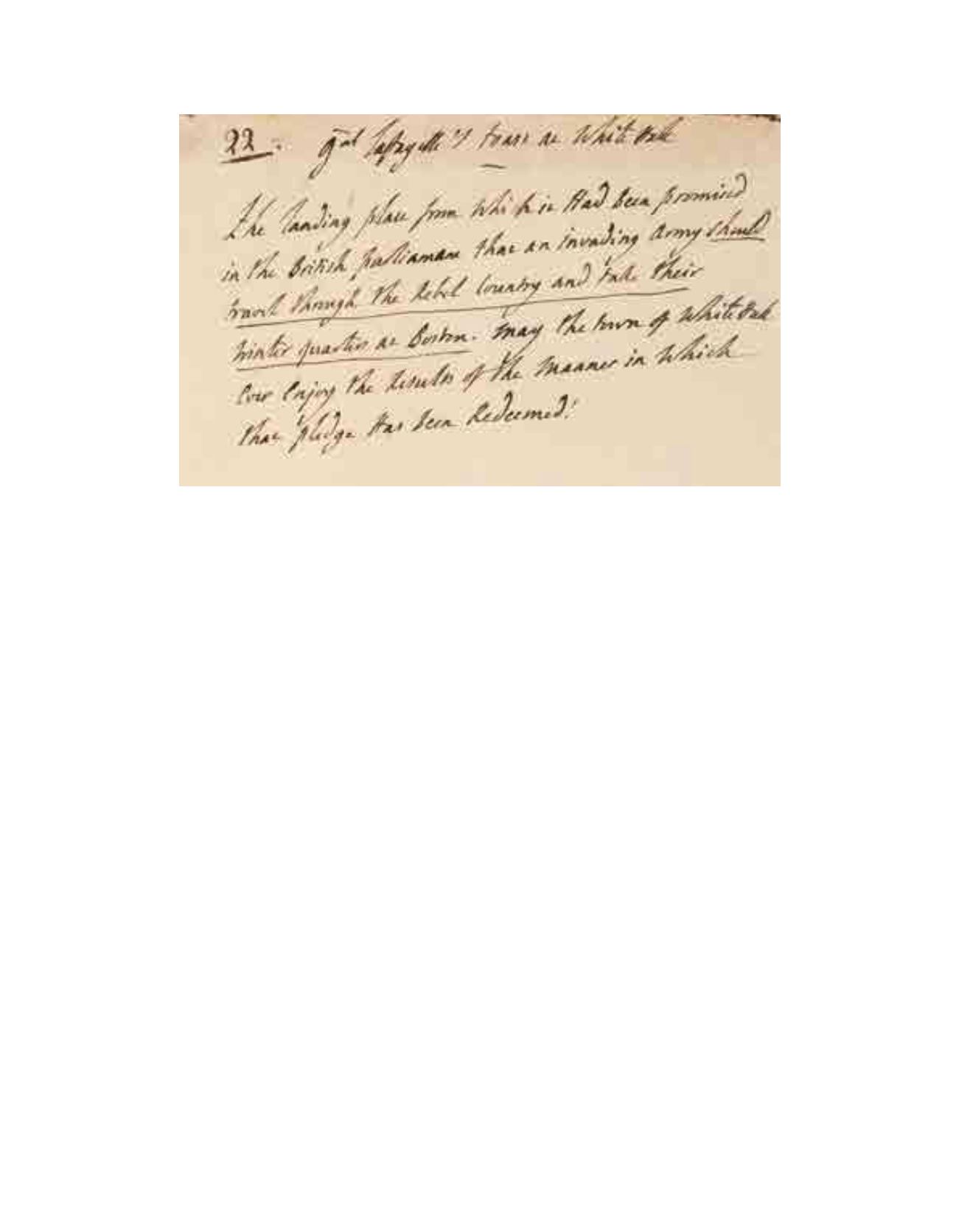
[Toast 22] Document autographe signé
Whitehall, 30 juin 1825
7 lignes
TOAST PRONONCÉ À WHITEHALL, SITUÉ À CÔTÉ DE
SARATOGA. EXEMPLAIRE DE LAFAYETTE.
TOAST IN WHITEHALL. LAFAYETTE’S COPY
“Gal Lafayette’s toast at Whitehall.
The landing place from which it had been promised in the British
parliament that an invading army should travel through the rebel country
and take their winter quarters at Boston : May the town of Whitehall ever
enjoy the result of the manner in which that pledge has been redeemed”
“The following day, June 30, about noon, we arrived at Whitehall,
where General Lafayette disembarked under a canopy formed
of two hundred flags of all nations, to the thunder of artillery,
and between two lines of girls who scattered flowers over
him as he passed. Whitehall is celebrated in the history of the
Revolutionary war. General Burgoyne boasted in Parliament, at
London, that those whom he called the rebels of America, were
soon incapable of resisting, that with five thousand regular troops
he would march from Canada to Boston, where he would take
up his winter quarters. He embarked in fact with his army on
Lake Champlain, disembarked at Whitehall, and not far from the
latter place, at Saratoga, he was compelled to capitulate, and
passed, it is true, the winter at Boston, but as a prisoner of war”
(Levasseur,
Lafayette in America
, II, p. 215)
2 000 / 3 000
€
- Toast -
260