
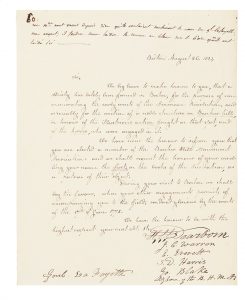
[LAFAYETTE, Gilbert du Motier, marquis de] Lettre signée par Henry Dearbon, membre de la Bunker Hill Monument Association Boston, 26 août 1824. 1 p. in-4
Estimation :
2000 / 3000
Adjudication :
Invendu
Description
EXEMPLAIRE DE LAFAYETTE : “THE ERECTION OF A NOBLE STRUCTURE AT BUNKER HILL". PRÉVUE POUR LE 17 JUIN 1825, JOUR DU CINQUANTIÈME ANNIVERSAIRE DE LA BATAILLE DE BUNKER HILL ; LA POSE DE LA PREMIÈRE PIERRE DE CE CÉLÈBRE MONUMENT DONNA LIEU À UNE GRANDE FÊTE MAÇONNIQUE À LAQUELLE ASSISTÈRENT PLUS DE 200.000 PERSONNES Promulgation officielle annonçant à Lafayette qu’une “Society has lately been formed in Boston, for the purpose of commemorating the early events of the American Revolution, and especially for the erection of a noble structure on Bunker hill, in honour of the illustrious action fought on that spot, and of the heroes, who were engaged in it", demande est faite à Lafayette de s’enregistrer comme “the first on the books of the Association, as a patron of the object (...) During your visit to Boston we shall beg the favour, when your other engagements permit, of accompanying you to the field, rendered glorious by the events of the 17th of June 1775", signé par Henry Dearborn et sans doute de la main de George Blake et au nom de J.C. Warren, E. Everett et S.D. Harris ; avec une mention de Levasseur annonçant que “ils voulaient seulement le nom de Lafayette, sans argent" The fiftieth anniversary celebrations of the Battle of Bunker Hill and Lafayette’s laying of the foundation stone of the celebrated Memorial was in many ways the culminating event of his tour of America, and one around which his other commitments were arranged. The ceremony took place on 17 June 1825. After an enormous process had made its way to the site of the proposed monument : “silence was established throughout the innumerable crowd, who waited in religious meditation for the commencement of the ceremony, the Grand Master of the Grand Lodge of Massachusetts, accompanied by the Principal of the Order, Brother Lafayette, Mr Webster and the Principal Architect, proceeded to lay the first stone, with the forms prescribed by masonic regulations... The procession then marched to a vast amphitheatre constructed on the north-east side of the hill, in the centre of which rose a platform, from which the orator of the day could make his voice heard by the fifteen thousand auditors placed in the amphitheatre ; all the officers and soldiers of the Revolution, some of whom had arrived from distant places to assist at this solemnity, were seated in front of the platform ; the survivors of Bunker’s hill forming a small group before them. At the head of these, in a chair, was the only surviving general of the Revolution, General Lafayette ; and immediately behind, two thousand ladies, in brilliant dresses, appeared to form a guard of honour to the venerable men, and to defend them against the tumultuous approaches of the crowd ; behind the ladies were more than ten thousand persons seated on the numerous benches placed in a semi-circular form on the side of the hill, the summit of which was crowded by more than thirty thousand spectators, who, although beyond the reach of the orator’s voice, maintained the most perfect silence. After the agitation that inevitably accompanies the movement of so large a concourse had subsided, the melodious voices of a great number of musicians were heard... At last, the orator of the day, Mr Webster, presented himself... During his speech, the orator was sometimes interrupted by bursts of applause from his auditory, who could not retain the expression of their sympathetic feelings, when Mr Webster addressed himself to the Revolutionary veterans and General Lafayette, and they, uncovering their venerable heads, arose to receive the thanks he bestowed upon them in the name of the people’ (Lafayette in America, II, 203-205).