
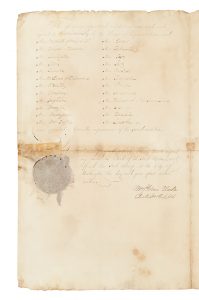
[LAFAYETTE, Gilbert du Motier, marquis de]. Document signé Mathew St Clair, “Clerk of the House" Washington, House of Representatives, 7 décembre 1824 2 pp. in-folio, avec la trace du grand sceau de la Chambre des Représentants. Taches...
Estimation :
8000 / 12000
Adjudication :
Invendu
Description
d’humidité, pli central fragile, traces de scotch, mais néanmoins en bon état
LE PREMIER ÉTRANGER REÇU PAR UNE CHAMBRE AMÉRICAINE. EXEMPLAIRE DE LAFAYETTE : “THAT HE BE INTRODUCED BY THE COMMITEE AND RECEIVED BY THE MEMBERS STANDING UNCOVERED, AND ADDRESSED BY THE SPEAKER IN BEHALF OF THE HOUSE". LAFAYETTE IS THE FIRST FOREIGNER TO ADDRESS AN AMERICAN CHAMBER. LAFAYETTE’S COPY Promulgation officielle de la Chambre des Représentants des États-Unis, transmise à Lafayette, avec la trace du sceau de la Chambre, signée et attestée par le “Clerk of the House", un Committee a été choisi pour recevoir Lafayette et il recommande deux résolutions acceptées à l’unanimité : “1st Resolved, That the Congratulations of this House be publicly given to General Lafayette, on his arrival in the United States, in compliance with the wishes of Congress ; and that he be assured of the gratitude and deep respect which the House entertains for his signal and illustrious services in the Revolution, and the pleasure it feels in being able to welcome him after so many years to the theatre of his early labour and early renown. 2d Resolved, That for this purpose, General Lafayette be invited by a Committee to attend the House on Friday next at One o’clock ; that he be introduced by the Committee and received by the members standing uncovered, and addressed by the Speaker in behalf of the House, in pursuance of the foregoing resolution" Donnant la liste des 24 membres du Committee, signé pour attestation par StClair : “In Testimony of all which, I have hereto signed my name as Clerk of the Said House, and affixed the Seal thereof, at the City of Washington, the day and year first within written Mw StClair Clarke Clerk Ho Rep. US" This was the first time in the history of the Republic that any foreign national had been invited before Congress. A similar honour was not to be conferred on another foreign dignitary until the King of Hawaii was invited in 1874. Churchill - the first foreigner to share with Lafayette the distinction of the being an honorary citizen of the United States - was to give three addresses, and from the later twentieth century the honour was to become relatively commonplace. In Levasseur’s account : “At half past twelve we went in carriages with the committee of the Senate to the Capitol ; at ten o’clock precisely the doors of the senate were thrown open, and General Lafayette was led into the midst of the assembly by Mr Barbour, President of the Committee. On arriving at the centre of the hall, Mr Barbour said, in a loud voice, “We introduce general Lafayette to the Senate of the United States." The senators standing uncovered received this annunciation with the most profound silence. The Committee then conducted the general to a seat on the right of Mr Gailliard, President of the Senate ; a motion to adjourn was made immediately after, that each senator might individually pay his respects to the general... The next morning, the General was again conducted to the Capitol, by a deputation of twenty-four members of the House of Representatives. The procession consisted of merely twelve coaches, but without escort, pomp, or decorations ; our progress through the city was slow and silent. At the sight of the first coach, which contained the General, the citizens halted, removed their hats, but uttered no exclamations... When the members had taken their seats, Mr Condict proposed that the Senate should be invited to attend... The Senate then entered and took their seats... A signal being then given, the doors were thrown open, and General Lafayette entered between Messrs Mitchell and Livingston, followed by the rest of the deputation : the whole assembly arose and stood uncovered in silence. When the general reached the centre of the hall, the speaker, Mr Clay, thus addressed him"... (Lafayette in America, II, pp. 13-14).
LE PREMIER ÉTRANGER REÇU PAR UNE CHAMBRE AMÉRICAINE. EXEMPLAIRE DE LAFAYETTE : “THAT HE BE INTRODUCED BY THE COMMITEE AND RECEIVED BY THE MEMBERS STANDING UNCOVERED, AND ADDRESSED BY THE SPEAKER IN BEHALF OF THE HOUSE". LAFAYETTE IS THE FIRST FOREIGNER TO ADDRESS AN AMERICAN CHAMBER. LAFAYETTE’S COPY Promulgation officielle de la Chambre des Représentants des États-Unis, transmise à Lafayette, avec la trace du sceau de la Chambre, signée et attestée par le “Clerk of the House", un Committee a été choisi pour recevoir Lafayette et il recommande deux résolutions acceptées à l’unanimité : “1st Resolved, That the Congratulations of this House be publicly given to General Lafayette, on his arrival in the United States, in compliance with the wishes of Congress ; and that he be assured of the gratitude and deep respect which the House entertains for his signal and illustrious services in the Revolution, and the pleasure it feels in being able to welcome him after so many years to the theatre of his early labour and early renown. 2d Resolved, That for this purpose, General Lafayette be invited by a Committee to attend the House on Friday next at One o’clock ; that he be introduced by the Committee and received by the members standing uncovered, and addressed by the Speaker in behalf of the House, in pursuance of the foregoing resolution" Donnant la liste des 24 membres du Committee, signé pour attestation par StClair : “In Testimony of all which, I have hereto signed my name as Clerk of the Said House, and affixed the Seal thereof, at the City of Washington, the day and year first within written Mw StClair Clarke Clerk Ho Rep. US" This was the first time in the history of the Republic that any foreign national had been invited before Congress. A similar honour was not to be conferred on another foreign dignitary until the King of Hawaii was invited in 1874. Churchill - the first foreigner to share with Lafayette the distinction of the being an honorary citizen of the United States - was to give three addresses, and from the later twentieth century the honour was to become relatively commonplace. In Levasseur’s account : “At half past twelve we went in carriages with the committee of the Senate to the Capitol ; at ten o’clock precisely the doors of the senate were thrown open, and General Lafayette was led into the midst of the assembly by Mr Barbour, President of the Committee. On arriving at the centre of the hall, Mr Barbour said, in a loud voice, “We introduce general Lafayette to the Senate of the United States." The senators standing uncovered received this annunciation with the most profound silence. The Committee then conducted the general to a seat on the right of Mr Gailliard, President of the Senate ; a motion to adjourn was made immediately after, that each senator might individually pay his respects to the general... The next morning, the General was again conducted to the Capitol, by a deputation of twenty-four members of the House of Representatives. The procession consisted of merely twelve coaches, but without escort, pomp, or decorations ; our progress through the city was slow and silent. At the sight of the first coach, which contained the General, the citizens halted, removed their hats, but uttered no exclamations... When the members had taken their seats, Mr Condict proposed that the Senate should be invited to attend... The Senate then entered and took their seats... A signal being then given, the doors were thrown open, and General Lafayette entered between Messrs Mitchell and Livingston, followed by the rest of the deputation : the whole assembly arose and stood uncovered in silence. When the general reached the centre of the hall, the speaker, Mr Clay, thus addressed him"... (Lafayette in America, II, pp. 13-14).