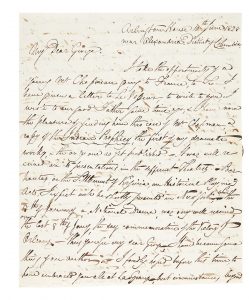
CUSTIS, George Washington Parke Lettre autographe signée à Georges Washington Lafayette Arlington House, 10 juin 1828 3 pp. in-4, trace du cachet déchiré, suscription “To Georges Washington Lafayette Esqr La Grange"
Estimation :
2000 / 3000
Adjudication :
Invendu
Description
BELLE ET TOUCHANTE LETTRE DU FILS ADOPTIF DE GEORGE WASHINGTON AU FILS DE LAFAYETTE, AU SUJET DE LEURSPÈRE S RESPECTIFS ET DE LA VISITE DE LAFAYETTE À LA TOMBE DE WASHINGTON “I fondly hope before this time to come to embrace you at La Grange but circumstances beyond my control have prevented me", il parle des pièces de théâtre qu’il écrit et va publier des extraits “in the National Intelligence & other American papers of my Private Memoirs of Washington", il lui demande d’obtenir de son père “the invaluable memoranda, which your father & he alone can now furnish. May I again entrust you, my dear George, to call his attention to the arrangement of his papers touching the Am[erican] Revolution", suivent des propos éditoriaux sur ce projet “a superb & vast touching embellishment to it would be Lafayette at the tomb of Washington (...) a lithograph of the tomb taken from your beautiful drawing is now in this country. I have no more to relate. We hear often of you, indeed the American papers may be called Bulletins de La Grange (...) Present me with filial veneration à notre père, kindly and affectionately" George Washington Parke Custis (1781-1857), was the step-grandson and adopted son of President George Washington, and father-in-law of Robert E. Lee. He spent his large inherited fortune building Arlington House on the Potomac opposite Washington, D.C. After his death, the estate was left to the Lee family. The Congress bought the estate back from the family which is now the Robert E. Lee Memorial and the plantation became Arlington National Cemetery and Fort Myer. He also wrote historical plays about Virginia and a memoir of life in the Washington household. We do not know today’s location of the original drawing by G. W. Lafayette of the historical visit of his father to Washington’s tomb. “Lafayette descended alone in the vault, and a few minutes thereafter reappeared, with his eyes overflowing with tears. He took his son and me by the hand, and led us into the tomb... We knelt reverentially near his coffin, which we respectfully saluted with our lips ; rising, we mingled our tears with his." (Levasseur, Lafayette in America).