

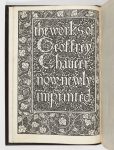
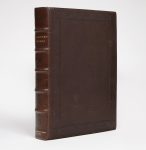
CHAUCER, Geoffrey. The Works of Geoffrey Chaucer now newly imprinted. Hammersmith (Middlesex), William Morris at the Kelmscott Press, 1896. In-folio (425 x 183 mm) de (8)-554-(2) pp. : maroquin brun décoré à froid, dos à cinq nerfs, entrenerfs...
Estimation :
15 000 / 20 000 €
Adjudication :
52 634 €
Description
décorés de fleurons quadrilobés, plats encadrés d'une bordure de filets, losanges et fleurons à froid, bordure intérieure ornée d'une large guirlande, non rogné (reliure postérieure).
►Le chef-d'œuvre des Kelmscott Press et de l'esthétique préraphaélite.
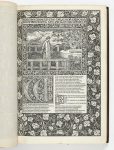
L'ouvrage, imprimé en noir et rouge, est orné de 87 grandes figures dessinées par Edward Burne-Jones (1833-1898) et d'innombrables ornements végétaux (bordures, initiales, lettrines) dessinés par William Morris, le tout gravé sur bois par William Harcourt Hooper (1834-1912).
■C'est le plus beau livre sorti des Kelmscott Press, imprimerie fondée en 1891 par l'écrivain, poète, peintre et designer socialiste William Morris (1834-1896), membre de la Confrérie préraphaélite (Pre-Raphaelite Brotherhood) animée par Dante Gabriel Rossetti, et inspirateur
du mouvement esthétique antimoderniste Arts & Crafts.
"The Kelmscott Chaucer set a new benchmark for book design at the end of the 19th century. It was also the last great project of Morris’s life, bringing together two of his passions. First, his love of medieval literature, which inspired the subjects and style of much of his own writing. Second, his socialist philosophy, which looked back to a time before mechanisation and division of labour had destroyed, as he saw it, the personal fulfilment and social function of meaningful work.
The book was exceptional in its ambitious number of illustrations and rich decorative borders.
If we live to finish it, Burne-Jones wrote, it will be like a pocket cathedral – so full of design and I think Morris the greatest master of ornament in the world. (...)
Early in 1892, two trial pages were set in one of Morris’s types, called ‘Troy’. The results were not satisfactory, the problem being the type size. A smaller version of the same design was cut, and christened ‘Chaucer’. Morris had intended to begin designs for the decorative borders immediately, but illness prevented him from starting until a year later. Meanwhile, Edward Burne-Jones spent every Sunday on the book’s 87 illustrations, working long hours in fear that Morris might die before the project was finished. His pencil drawings were painted over in Chinese white and Indian ink by R. Catterson-Smith, whose interpretive role is often overlooked. The black-and-white designs were then transferred to wooden blocks and engraved by William Harcourt Hooper" (British Library).
→Tirage à 438 exemplaires, dont 13 sur vélin et 48 sous reliure spéciale de l'éditeur.
Cet exemplaire, sur vergé de Hollande fabriqué à la main – Morris avait en horreur les procédés mécaniques –, est revêtu d'une belle reliure en maroquin réalisée au XXe siècle.
Provenance :
•Jean A. BONNA (ex-libris).
W.S. Peterson, The Kelmscott Press, Oxford University Press, 1991, pp. 228-257. – British Library, The Kelmscott Chaucer (en ligne).
►Le chef-d'œuvre des Kelmscott Press et de l'esthétique préraphaélite.
L'ouvrage, imprimé en noir et rouge, est orné de 87 grandes figures dessinées par Edward Burne-Jones (1833-1898) et d'innombrables ornements végétaux (bordures, initiales, lettrines) dessinés par William Morris, le tout gravé sur bois par William Harcourt Hooper (1834-1912).
■C'est le plus beau livre sorti des Kelmscott Press, imprimerie fondée en 1891 par l'écrivain, poète, peintre et designer socialiste William Morris (1834-1896), membre de la Confrérie préraphaélite (Pre-Raphaelite Brotherhood) animée par Dante Gabriel Rossetti, et inspirateur
du mouvement esthétique antimoderniste Arts & Crafts.
"The Kelmscott Chaucer set a new benchmark for book design at the end of the 19th century. It was also the last great project of Morris’s life, bringing together two of his passions. First, his love of medieval literature, which inspired the subjects and style of much of his own writing. Second, his socialist philosophy, which looked back to a time before mechanisation and division of labour had destroyed, as he saw it, the personal fulfilment and social function of meaningful work.
The book was exceptional in its ambitious number of illustrations and rich decorative borders.
If we live to finish it, Burne-Jones wrote, it will be like a pocket cathedral – so full of design and I think Morris the greatest master of ornament in the world. (...)
Early in 1892, two trial pages were set in one of Morris’s types, called ‘Troy’. The results were not satisfactory, the problem being the type size. A smaller version of the same design was cut, and christened ‘Chaucer’. Morris had intended to begin designs for the decorative borders immediately, but illness prevented him from starting until a year later. Meanwhile, Edward Burne-Jones spent every Sunday on the book’s 87 illustrations, working long hours in fear that Morris might die before the project was finished. His pencil drawings were painted over in Chinese white and Indian ink by R. Catterson-Smith, whose interpretive role is often overlooked. The black-and-white designs were then transferred to wooden blocks and engraved by William Harcourt Hooper" (British Library).
→Tirage à 438 exemplaires, dont 13 sur vélin et 48 sous reliure spéciale de l'éditeur.
Cet exemplaire, sur vergé de Hollande fabriqué à la main – Morris avait en horreur les procédés mécaniques –, est revêtu d'une belle reliure en maroquin réalisée au XXe siècle.
Provenance :
•Jean A. BONNA (ex-libris).
W.S. Peterson, The Kelmscott Press, Oxford University Press, 1991, pp. 228-257. – British Library, The Kelmscott Chaucer (en ligne).