Description
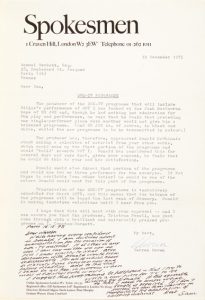
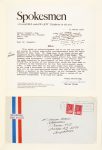
Correspondance avec Warren Brown. Ussy-sur-Marne, Paris, Berlin, Tanger, Londres, 27 mars 1969 - 27 avril 1977.
32 billets autographes, 5 lettres tapuscrites avec réponse autographe, signés, 17 enveloppes, tapuscrit de 11 pages, montés sur papier vélin format in-folio, reliés en demi-maroquin bleu à coins, dos à nerfs (Loutrel).
L'intense production dramatique de Samuel Beckett au milieu des années 1970.
Les 37 billets autographes adressés par le dramaturge à son agent Warren Brown (de l'agence londonienne Curtis Brown) révèlent le rôle crucial que joua la télévision dans sa production dramatique dont le rayonnement international était considérable depuis l'attribution du prix Nobel en 1969. Elle révèle également un auteur engagé politiquement qui s'oppose de manière catégorique à toute représentation de ses pièces en Afrique du Sud devant un public ségrégé. Ainsi répond-il d'un laconique “No question” à la suggestion d'un directeur de théâtre de monter Not I au Space Theater à Cape Town (Paris, 18.3.74).
Un grand nombre de documents se rapportent aux projets élaborés par la BBC en 1976 pour célébrer les 70 ans de l'auteur, en premier lieu un enregistrement de la pièce
Not I. Accaparé par les répétitions de la nouvelle production allemande d'En attendant
Godot au Schillertheater, Beckett s'implique d'abord peu dans ce projet: “I leave to Billie & yourself the final decision regarding TV film of Not I. No need for me to see the film in Paris; Here I have by now purged all past sins plus those (I trust) still to come” (Berlin, 19.2.75).
Réalisé par Tristram Powell, avec Billie Whitelaw dans le rôle unique, l'enregistrement fut des plus réussis: “On 13 February 1975, the producer, Tristram Powell, had the camera set up in front of Billie Whitelaw's mouth - the Auditor having been discarded - and Mouth appeared on the screen in powerful close-up. The film had to be shot with an extra large reel of film to avoid breaks in the take. Approved by
Billie Whitelaw at a private showing, the film of Not I lay waiting for Beckett's final approval. Tristram Powell wrote to Beckett that: «There's no doubt that the close-up of the mouth, held uncut for the length of the play, makes an extraordinary impression. Every word comes over with complete clarity and although it is totally different from the theatre experience, it makes its own hallucinatory effect on film.
For once, a transfer to another medium had worked brilliantly in its own terms” (James Knowlson, Damned to Fame. The Life of Samuel Beckett, 1996).Cherchant à compléter le programme, la BBC se heurta à des difficultés, manquant de matériel exploitable. Beckett propose ainsi l'écriture d'une nouvelle pièce et le report de l'hommage télévisé: “I suggest this programme be postponed & that I try to write a new piece for TV to be directed by Donald.
Is this agreeable to BBC I need to know what length is required. If I don't succeed we can then consider in tranquillity the adaption of existing material ” (Paris, 16.02.75).
La chaîne accepta sans discussion le report du programme à l'automne 1976, dans l'attente d'une nouvelle pièce de Beckett écrite pour l'occasion. En janvier 1976, Beckett proposa d'y intégrer Footfalls, composé pendant et après son séjour à Berlin, toujours pour sa favorite, Bille Whitelaw: “I have heard from the Court that they wd. Like to include Footfalls in their season.
I have answered that Billie & they must first read the play, which is not found to please, and that if then they still want it, and Billie has no objection, they may add it to the triple bill” (Tanger, 19.1.76).
En revanche, il s'oppose à l'adaptation d'En attendant Godot avec un laconique “TV Godot. Definitely no” (Paris, 17.2.76). De même, la traduction de That Time se fait attendre: “I have not yet begun translation of That Time and don't know when I shall. I hate so much the thought of this idea that I keep pushing it off ” (Paris, 18.2.76).
Tout comme la réalisation du projet BBC: “I shall be in Berlin all September to direct That Time & Footballs for the Schiller Werkstatt, so could not be in London to lend a hand with Tryst before October 3 or 4.”
En juin 1976, le script définitif de la pièce télévisée voit le jour, comme en témoigne l'exemplaire expédié le 9 juin depuis Paris. Intitulé originairement Tryst, la pièce portera le titre de Ghost Trio, d'après le 5e trio pour piano de Beethoven dont le Largo fut sa source d'inspiration première (Ussy, 15.7.76: “I should like to change title of TV piece from Tryst to Ghost Trio” ).
Le 20 juillet, il est question de l'usage de la caméra: “I sent Donald, at his request, suggestions as to use of camera in Play. I hope he will adopt them, but he must consider himself free. I proposed brief close-ups of three faces with only necks of urns showing, but no individual close-ups. The togetherness should never be lost.”La correspondance évoque ensuite une nouvelle pièce télévisée devant se substituer à Play [Comédie]: “If found it will be for Billie & Ronald alone, in the same mood as G.T., about the required length & ready in time. If not I' ll call it off before end of year.
The outcome is too doubtful to... Faber, at this stage - with possible inclusion in E.&O.
If available for BBC, no reason why Stuttgart should not have it to - if they want it” (Paris, 28.10.76).
Le 24 novembre 1976, il autorise le compositeur Heinz Holliger de mettre en musique des extraits de Not I et Come & Go; le 8 décembre, il donne son aval à la BBC pour distribuer ses productions de Not I, Ghost Trio et But the Clouds. Leur diffusion interviendra finalement en avril 1977.
Après des échanges rapprochés au courant des années 1975-1976, la correspondance se termine par un ultime billet adressé à Warren Brown depuis Tanger le 27 avril 77. L'agent avait mis, en décembre 1976, un terme à sa fonction chez Curtis Brown - et à cinq ans de collaboration avec Beckett - pour se consacrer à l'écriture. Beckett le remercie de son avis précieux: “Your opinion means a lot to me. There are some technical weakness - the lighting of Ghost Trio for ex. & some of the close-ups - which I hope to eliminate in Stuttgart next month & June. Here in peace making ready for that....
I think of you in your retreat and hope your writing is going well and that we shall meet again before too long”.
Un billet du 19 août 1972, à propos de Not I, est adressé à Richard Odgers, le directeur de l'agence littéraire Curtis Brown.
Une seule de ces lettres a été publiée dans The Letters of Samuel Beckett 1966-1989, 2016, p. 431. Dans la biographie de Beckett par James Knowlson (Damned to Fame, The Life of
Samuel Beckett, 1996), la lettre du 15 septembre 1975 est partiellement reproduite et celle du 24 novembre 1976, à propos de Heinz Holliger, est évoquée.