Lot n° 129

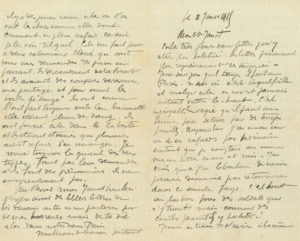
LÉGER FERNAND (1881-1955). — L.A., 11 janvier 1915, à Jeanne LOHY ; 4 pages in-8, enveloppe à «Madame Léger». — Belle et émouvante lettre du front en Argonne, à sa marraine de guerre et future femme.

Estimation : 1000 - 1500
Adjudication : 1 820 €
Description
[Jeanne LOHY (1895-1950), rencontrée avant la guerre dans les milieux artistiques, fut la marraine de guerre de Fernand Léger, qui l'épousera officiellement en 1919. La lettre est adressée à «Madame Léger» chez «Serge Jabstrebzoff», le peintre Serge Férat.]

«Mon cher Janot, voilà trois jours sans lettres je n'y étais plus habitué. [...] Je ne sais pas quel temps il fait à Paris, mais ici c'est inqualifiable et malgré cela on ne s'est jamais autant battu là-haut. C'est incroyable l'énergie qu'il faut aux hommes pour se tuer par des temps pareilles. Aujourd'hui j'ai encore un de ces cafards pas ordinaire, surtout que je comptais au moins sur une lettre ce soir et rien. Je crois que si j'ai le bonheur de revenir jamais de ma vie je ne retournerai dans ce sinistre pays. C'est tout au plus bon pour des soldats qui s'y tuent. Mais comment des civils peuvent-ils y habiter ? [...] j'entends toujours cette sacrée mitrailleuse qui tient à se faire entendre chaque fois que je t'écris. On doit attaquer dur du côté du 2e corps Toute la journée une canonnade formidable, et ensuite lorsque l'on pousse à fond, c'est l'infanterie et les mitrailleuses. [...] Dire qu'à la minute où je t'écris il y a des hommes qui sous une pluie glacée qui tombe en rafale, dans de la boue jusqu'aux genoux, se lancent les uns sur les autres à coups de baïonnette. Pense, Janot, à ce qu'ils feraient s'il n'étais pas à la guerre [...] Pense à tous ces pauvres gars qui sont en train de crever tout doucement en pleine connaissance entre deux tranchées, sachant qu'ils vont y mourir sans aucun secours. Avant-hier tout un peloton de ma compagnie a été enveloppé. Nous restons 4 de l'escouade sur 15. Que sont-ils devenus. On ne le saura jamais. Nous savons par qquns qui ont pu se sauver qu'ils ont tenu presque jusqu'au bout. Quand ils n'ont plus eu de cartouches ils ont pris les pioches et les barres à mine, ils se sont battus comme des sauvages après avoir passé 16 jours là-haut avec un repas par jour. Quand on apprend après cela qu'il y a des premières au Moulin-Rouge cela vous casse les pattes. C'est terrible de penser que Paris rigole et que tant de pauvres diables se font casser la figure. Je m'aperçois, mon Janot, que je t'écris une lettre sinistre. Il y a des jours comme cela où l'on voit les choses comme elles sont, cruement en plein cafard ce soir je les vois tel quel». Il raconte le passage de deux coloniaux blessés avec qui il a partagé des conserves, «et pour ouvrir les boîtes de “singe” ils ont comme l'ont fait toujours sorti leur baïonnette elles étaient pleines de sang. Ils ont fourré cela dans la boîte et ils étaient étonnés que plusieurs aient refusé d'en manger. [...] Au revoir mon Janot très chéri. J'espère avoir des belles lettres de toi demain où tu ne me parleras pas de mes horreurs mais de ta vie à toi dans notre vieux Paris. Millions de baisers partout.»

L.A., January 11, 1915, to Jeanne LOHY ; 4 pages in-8, envelope to "Madame Léger". — Beautiful and moving letter from the front in Argonne, to his wartime godmother and future wife. [Jeanne LOHY (1895-1950), met before the war in artistic circles, was the wartime godmother of Fernand Léger, who officially married her in 1919. The letter is addressed to "Madame Léger" at "Serge Jabstrebzoff", the painter Serge Férat]. "My dear Janot, here are three days without letters I was no longer used to them. [...] I don't know what the weather is like in Paris, but here it's unbearable, and in spite of that we've never fought so hard up there. It's incredible the energy it takes for men to kill themselves in such weather. Today I've got another one of those unusual cockroaches, especially as I was counting on at least one letter this evening and nothing. I think that if I am fortunate enough to return I will never in my life go back to that sinister country. It is at most good for soldiers who kill themselves there. But how can civilians live there? [...] I can still hear that damn machine gun, which insists on being heard every time I write to you. We have to attack hard on the side of the 2nd Corps. All day a formidable cannonade, and then when we push hard, it is the infantry and the machine guns. [...] To think that at the minute I am writing to you there are men who, in the freezing rain that is falling in gusts, in mud up to their knees, are throwing themselves at each other with bayonets. Think, Janot, of what they would be doing if they were not at war [...] Think of all those poor fellows who are dying slowly in the knowledge that they are going to die there without any help. The day before yesterday a whole platoon of my company was enveloped. We are left with 4 of the squad out of 15. What happened to them? We'll never know. We know from some who were able to save themselves that they held out almost to the end. When they ran out of ammunition they took pickaxes and crowbars, they fought like savages after spending 16 days up there with one meal a day. When you learn after that that there are premieres at the Moulin-Rouge, it breaks your legs. It's terrible to think that Paris is laughing and that so many poor devils are being beaten up. I realise, my Janot, that I am writing you a sinister letter. There are days like that when one sees things as they are, and tonight I see them as they are. He tells of the passage of two wounded colonials with whom he shared canned goods, "and to open the cans of 'monkey' they did as they always do, pull out their bayonets and they were full of blood. They stuffed it in the can and they were surprised that many refused to eat it. [...] Goodbye my dearest Janot. I hope to get some nice letters from you tomorrow where you won't tell me about my horrors but about your own life in our old Paris. A million kisses everywhere."
Partager