Les droits et les devoirs des femmes dans le sexe, l'amour et le
Estimation :
120 / 150
Adjudication :
140 €
Description
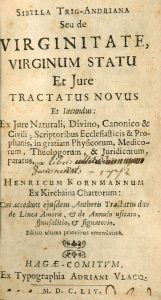
mariage.- KORNMANN (Heinrich). Sibylla Trig-Andriana seu de Virginitate, virginum statu et jure tractatus novus et iucundus [...]. Hagae-Comitum [à La Haye], Ex Typographia Adriani Vlacq, 1654, in-32, [24]-214-[2 blanches]-117-[3]-69-[3] p., plein veau brun moucheté du 18e s., dos lisse orné (coiffes arasées, mors en partie fendus, bas du f. de titre renforcé, très lég. bruniss.). Rare first complete Netherlands edition of three curious Latin works on women, love and marriage, by Heinrich Kornmann : « Sibylla trig-Andriana », « De linea amoris » and « De annulo usitato », published together, at least the first two first published at Frankfurt in 1610. The first treats the rights and duties of women and their conduct in matters of sex, the second is about the commonplace of the five stages of love (sight, conversation, physical contact, kissing and consummation) and the third is devoted to rings, including engagement rings. Kornmann refers to a wide variety of sources, including classical authors and church fathers. He defends women's rights to some degree, but also repeats superstitious beliefs such as that a tree is injured by a virgin's plucking its first fruit. He further discusses incubi and succubi, astrology and the colour of women's cloths (preferably blue, pink, green and white). Robert Burton refers to « De linea amoris » in his 1621 « Anatomy of melancholy », and all three works enjoyed widespread popularity far into the 18th century. The present edition appears to be the only one with a Netherlands imprint, though a 1631 edition in the STCN, perhaps containing the first work only and giving its place of publication as « Virginopoli » may be Dutch. Kornmann, a lawyer from Kirchhain (Germany), also published several works on miracles. Michaud apparently found Kornmann's discussion of sexual matters too frank, writing in 1818 that he had great erudition, but lacked taste and jugdement. The « De linea amoris » and « De annulo usitato » have their own title-pages and were probably issued separately as well, but the « Sibylla trig-Andriana » title-page explicitly mentions them (« Cui accedunt ejusdem authoris tractatus duo, de linea amoris, et de annulo usitato, sponsalito, et signoratoria ») making it clear that the three were designed to be issued together.