Avec la plus célèbre carte de l'Amérique du Nord.- LAHONTAN (Louis Armand, baron de). Voyages dans l'Amérique septentrionale, qui contiennent une relation des différens peuples qui y habitent ; la nature de leur gouvernement ; leur commerce,...
Estimation :
100 / 150
Adjudication :
280 €
Description
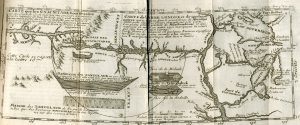
leurs coutumes, leur religion et leur manière de faire la guerre. L'intérêt des François et des Anglois dans le commerce qu'ils font avec ces nations ; l'avantage que l'Angleterre peut retirer de ce païs, étant en guerre avec la France. Le tout enrichi de cartes et de figures. Seconde édition revue, corrigée et augmentée. Tome 1./ IDEM. Suite du voyage de l'Amérique ou dialogues de Monsieur le baron de Lahontan et d'un sauvage de l'Amérique. Contenant une description des moeurs et des coutumes de ces peuples sauvages. Avec les voiages du même en Portugal et en Danemarc [...]. [Tome 3]. Amsterdam, Chez François L'Honoré [Amsterdam, Chez la Veuve de Boeteman], 1728, 2 vol. in-12 (sur 3, le tome 2 manque), [18]-408 p., 11 gravures h. t. et 4 planches dépliantes dont la vue panoramique de Québec, la carte générale du Canada et la célèbre carte de la rivière Longue ; 257-[1] p., 5 planches dépliantes dont 2 cartes du Portugal et du Danemark et 2 vues dépliantes de Lisbonne et Hambourg, pleine basane brune de l'époque, dos à 5 nerfs ornés de caissons dorés, pièces de titre (rel. épidermée, petits trous de vers à qq. ff.). Louis Armand, baron de Lahontan, served ten years in the French military in Canada, was involved in the Indian Wars, and commanded several posts in the west. He traveled extensively in the Wisconsin and Minnesota region and the upper Mississippi valley. Upon his return to Europe he wrote this enormously popular travelogue. In it he embellished his knowledge of the geography of the Great Lakes region, invented Indian tribe names, and created several fictions, particularly the "River Longe" extending from the Mississippi River to the Rocky Mountains. Over twenty editions of his book were published between 1703 and 1741, including editions in French, English, Dutch and German. The immense popularity of the book resulted in his distorted cartography being accepted by several eminent cartographers who incorporated the "Lahontan" concepts into most of the maps of the 18th century. Volume 1 includes the important folding map "Carte de la Riviere Longue et de quelque autres…". It is one of the most influential, and fanciful, maps in American cartographic history. It purports to show the Riviere Longue flowing from the mountains in the west, home to the Gnacsitares Indians, and connecting to the Mississippi River. On the western side of the mountains is another river, presumably flowing into the Pacific. Lahontan's concept was copied by virtually all 18th century cartographers including Moll, Senex, Popple, and Delisle, thus perpetuating the myth presented by this small but influential map. The map also includes balloon-shaped Lakes Superior and Michigan (Kershaw, 301). Also includes the maps : "Profile de la Ville de Quebec…" folding map from across the river ; "Carte Generale du Canada en Petit Point" ; untitled battle plan shows French and Indian positions ; and an untitled map of "la Grande Baye du Plaisance". Plus several engravings including the frontis "Planche du Titre" ; "Combat entre deux Vaisseaux Anglois et Francois" is a great battle between two three-masted ships firing cannons ; untitled showing several canoes and method of portage ; "Campement de Mr. de la Barre" ; untitled shows various methods of hunting deer ; plate of animals including eagle and bear ; "Lac des Hurons"; and a nice beaver plate (Sabin 38641-42).