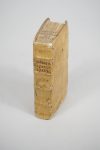
TACHENIUS, Otto. Hippocrates Chimicus, per Ignem et Aquam metodo inaudita novissimi Salis Viperini antiquissima fundamenta ostendens. Venezia, Combi e La Noe, 1678.
Estimation :
Start Price 400 € /
Description
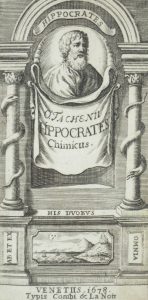
12m, mm. 145x77; Contemporary full vellum bindning, title written on the spine; pp. 34 nn, incl. Frontisiece and Titlepage, 473, 5 nn., 2 bl. Nice Frontispiece with portrait of Hippocrates, printer’s device on Titlepage. Note of possession on Titlepage “Del Dott Pietro”.
RARE SECOND VENETIAN EDITION INCREASED. It is added, starting on page 271, a second part with the title "De Morborum Prince Tractatus".Duveen: “
The work is interesting in that Tachenius raised objections to the air absorption theory which Rey had advanced to explain the increase of weight undergone by lead when it was calcined. He suggests the flame assumes a body of an acid nature in the lead and that this accounts for the increase in weight. He argues that the increase in weight be due to the absorption of air in the metal then the increase of weight... Tachenius had some idea of qualitative analysis, he defined a salt as a compound of an acid and an alkali...” Otto Tachenius fece il suo apprendistato in campo farmaceutico a Kiel, e nel 1644 si trasferì in Italia, addottorandosi a Padova e portando poi la sua attività in Venezia, dove aprì il suo laboratorio chimico. Ferguson: “he] sold quantities of a preparation which was known as Sal volatile viperarum, or Sal viperinum, which, however, Dieterich asserted was merely the volatile salt of hartshorn mixed with something else... Tachenius was a pronounced iatrochemist, and introduced to Italy the hypothesis of acid and alkali as the basis of physiology and pathology. He was not much of an anatomist, but he was a good chemist, with a clear understanding of reactions, and with a wide knowledge of substances and the practical method of preparation.” Per alcuni aspetti, secondo Duveen, Tachenius può essere considerato un anticipatore delle teorie di Boyle.
Krivatsy, n. 11657; Duveen, p. 569; Krivatsy, n. 11657.
Nice copy, printed on strong paper with wide margins.
RARE SECOND VENETIAN EDITION INCREASED. It is added, starting on page 271, a second part with the title "De Morborum Prince Tractatus".Duveen: “
The work is interesting in that Tachenius raised objections to the air absorption theory which Rey had advanced to explain the increase of weight undergone by lead when it was calcined. He suggests the flame assumes a body of an acid nature in the lead and that this accounts for the increase in weight. He argues that the increase in weight be due to the absorption of air in the metal then the increase of weight... Tachenius had some idea of qualitative analysis, he defined a salt as a compound of an acid and an alkali...” Otto Tachenius fece il suo apprendistato in campo farmaceutico a Kiel, e nel 1644 si trasferì in Italia, addottorandosi a Padova e portando poi la sua attività in Venezia, dove aprì il suo laboratorio chimico. Ferguson: “he] sold quantities of a preparation which was known as Sal volatile viperarum, or Sal viperinum, which, however, Dieterich asserted was merely the volatile salt of hartshorn mixed with something else... Tachenius was a pronounced iatrochemist, and introduced to Italy the hypothesis of acid and alkali as the basis of physiology and pathology. He was not much of an anatomist, but he was a good chemist, with a clear understanding of reactions, and with a wide knowledge of substances and the practical method of preparation.” Per alcuni aspetti, secondo Duveen, Tachenius può essere considerato un anticipatore delle teorie di Boyle.
Krivatsy, n. 11657; Duveen, p. 569; Krivatsy, n. 11657.
Nice copy, printed on strong paper with wide margins.