Description
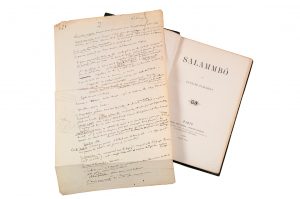
première émission avec des fautes notamment aux pages 5 «effraya» au lieu de «effrayèrent», 80 et 251 «Scissites» au lieu de «Syssites» et aux pages 368 et 370. Salammbô fût le deuxième roman publié par Gustave Flaubert. Après cinq années à décrire la petite bourgeoisie provinciale pour Madame Bovary, il se hâta à chercher un nouveau sujet, le plus éloigné possible. Fin mars 1857, sa décision fut prise «Je vais écrire un roman dont l'action se passera trois siècles avant Jésus-Christ, car j'éprouve le besoin de sortir du monde moderne, où ma plume s'est trop trempée et qui d'ailleurs me fatigue autant à reproduire qu'il me dégoûte à voir». Durant 59 mois, Flaubert se consacra à l'élaboration de Carthage, qui deviendra Salammbô. Il entreprit de se renseigner sur son sujet et découvrit les exigences d'une nouvelle méthode - l'écrivain-chercheur. Les travaux de recherches déployés pour l'écriture furent immenses; des centaines d'ouvrages mis en fiches, près de 2000 folios de brouillons. Il entama la rédaction en septembre 1857, phase qui suscita de nombreux doutes amenant à son voyage en Tunisie d'avril à juin 1858 afin de se documenter, d'observer et de s'imprégner du cadre de son histoire. A son retour, il révisa entièrement ses idées d'origine et acheva finalement l'écriture en avril 1862. «J'ai enfin terminé, dimanche dernier, à sept heures du matin, mon roman de Salammbô. Les corrections et la copie me demanderont encore un mois et je reviendrai ici dans le milieu de septembre, pour faire paraître mon livre à la fin octobre. Mais je n'en puis plus. J'ai la fièvre tous les soirs et à peine si je peux tenir une plume. La fin a été lourde et difficile à venir.» écrivit-il à Mlle Leroyer de Chantepie le 24 avril 1862. Salammbô parut en novembre 1862 chez Michel Lévy, et connut un rapide succès mondain, amplifié par une double polémique avec Sainte-Beuve qui considéra le roman comme un échec et reprocha à Flaubert de prendre des libertés avec les éléments établis par les archéologues. Flaubert se défendit avec véhémence ayant la conviction que son archéologie était probable et l'Orient immuable. L'on joint: Un très beau feuillet manuscrit de 2 pages in-folio, écrit recto et verso, avec ratures et corrections de la page 9 de l'édition originale concernant le récit de Spendius allant de «un grand soupir s'échappe de sa poitrine; il balbutiait, il ricanait sous les larmes claires qui lavaient sa figure» jusqu'à «et on avait un qui risquaient leur vie pour l'inconcevable plaisir d'y boire.». Le manuscrit joint présente de nombreuses variantes avec le texte imprimé à la page 9 de l'édition. Flaubert l'a barré de deux traits. Au verso, il a consigné deux nombreuses notes, titrées «II Politique», concernant la tribu des Lybiens, la manière dont se faisait le commerce, les Syssites, les mercenaires, etc. Ces notes ont servi à l'ouvrage et montrent le soin particulier avec lequel Flaubert travaillait ses textes. (Quelques petites restaurations à la couverture, feuillet manuscrit séparé en deux, quelques petites déchirures sans manque). Salammbô. Paris, Lévy Frères, 1863. In-8, dark green half-marquin with corners, spine ribbed with gilt fillets, untrimmed, spine and cover preserved (Binding signed Canape). Original edition. First issue copy with mistakes notably on pages 5 "effraya" instead of "effrairent", 80 and 251 "Scissites" instead of "Syssites" and on pages 368 and 370. Salammbô was the second novel published by Gustave Flaubert. After five years of describing the provincial petty bourgeoisie for Madame Bovary, he hastened to find a new subject, as far away as possible. At the end of March 1857, his decision was made: "I am going to write a novel whose action will take place three centuries before Christ, because I feel the need to get out of the modern world, where my pen has become too wet and which, moreover, tires me as much to reproduce as it disgusts me to see". For 59 months, Flaubert devoted himself to the development of Carthage, which would become Salammbô. He began to learn about his subject and discovered the requirements of a new method - the writer-researcher. The research work deployed for the writing was immense; hundreds of works were put in files, nearly 2000 folios of drafts. He began writing in September 1857, a phase that raised many doubts, leading him to travel to Tunisia from April to June 1858 to document, observe and immerse himself in the framework of its history. On his return, he completely revised his original ideas and finally completed the writing in April 1862. "I finally finished, last Sunday at seven o'clock in the morning, my novel of Salammbô. Corrections and copying will take another month and I will be back here in the middle of September, to publish my book at the end of October. But I can't take it anymore. I have a fever every night and I can barely hold a feather. The end was heavy and difficult to come to," he wrote to Miss Leroyer de Chantepie on April 24, 1862. Salammbô was published in November 1862 by Michel Lévy, and was a rapid social success, amplified by a double polemic with Sainte-Beuve, who considered the novel a failure and reproached Flaubert for taking liberties with the elements established by the archaeologists. Flaubert defended himself vehemently in the conviction that his archaeology was probable and the Orient immutable. Enclosed is: A very beautiful 2-page manuscript folio, written on both sides, with erasures and corrections from page 9 of the original edition concerning the account of Spendius ranging from "a great sigh escapes from his chest; he stammered, he sneered under the clear tears that washed his face" to "and we had one who risked his life for the inconceivable pleasure of drinking from it". The enclosed manuscript has many variants with the text printed on page 9 of the edition. Flaubert crossed it out with two strokes. On the reverse, he has written two numerous notes, entitled "II Politique", concerning the tribe of the Lybians, the way in which trade was conducted, the Syssites, the mercenaries, etc., and the way in which the people of Lyons were treated. These notes were used in the book and show the particular care with which Flaubert worked on his texts. (A few small restorations to the cover, a manuscript leaf separated in two, a few small tears without missing).